
Cambria Gold Mines Fast Tracks Red Mountain Road Build with the Support of the Nisga’a Nation
Cambria Gold Mines (TSXV: CAMB; OTCID: AOTVF) announced that it has begun rebuilding a 23-kilometer access road that will enable efficient transport of mineralized material from the Red Mountain project to Cambria’s 2,500-tonne-per-day mill at the Premier Mine.
Canada, 4th Jun 2026 – Global Stocks News – Sponsored content disseminated on behalf of Cambria Gold Mines. On June 1, 2026, Cambria Gold Mines (TSXV: CAMB; OTCID: AOTVF) announced that it has begun rebuilding a 23-kilometer access road that will enable efficient transport of mineralized material from the Red Mountain project to Cambria’s 2,500-tonne-per-day mill at the Premier Mine.
The Premier Gold Project has paved road access, a 2,500 per day mill, grid-connected hydroelectric power, and proximity to a deep-water port. Multiple deposits include Premier, Silver Coin, Big Missouri, Dilworth, and Martha Ellen.
Red Mountain is a high-grade underground gold deposit, located approximately 15 kilometres northeast of Stewart, BC, within Nisga’a Nation Treaty Lands, in BC’s Golden Triangle.
Cambria Gold Mines began trading on February 13, 2026. Four months is a short timeline to complete the permitting and engineering work required to green-light construction of an access road that traverses indigenous territory.
Premier and Red Mountain are both located on Nisga’a Nation Treaty Lands. Rob McLeod, President and CEO of Cambria, has a multi-generational connection with the Nisga’a. In the late 1940s, Rob’s father, Ian McLeod, helped run election campaigns for the late Dr. Frank Calder, the first Indigenous person to serve public elected office for any provincial legislature in Canada.
“I have a long-standing personal and business relationship with Eva Clayton – President of the Nisga’a,” McLeod told Guy Bennett, the CEO of Global Stocks News (GSN), “The Nisga’a are supportive of our goal to turn both the Premier and Red Mountain assets into producing mines. There is a level of trust between us that helps expedite permitting and decision-making.”
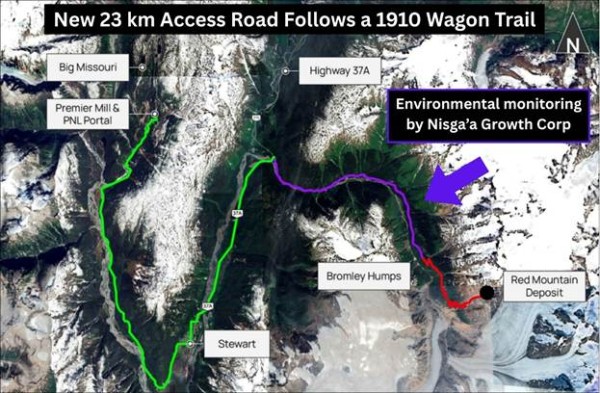
Phase 1 will focus on rebuilding a 13 km long road bed [purple section above]. It was built in 1910 as a wagon trail to access placer gold mines along Bitter Creek. Later, it was extended to the base of Red Mountain at Bromley Humps by Lac Minerals in 1994.
The road will start from the paved Highway 37A just North of Stewart. It is anticipated that mineralized material will be transported for processing at Cambria’s 2,500 tonne per day mill at the Premier Mine, for a total trucking distance of approximately 50 kilometers.
Cambria’s Red Mountain Gold Deposit hosts Measured and Indicated Resources of 3.19M tonnes averaging 7.63 g/t Au and 21.02 g/t Ag, for 783,000 ounces Au and 2,156,000 ounces Ag. The Deposit hosts additional Inferred Resources of 405,000 tonnes at 5.32 g/t Au and 7.33 g/t Ag for 69,000 ounces Au and 96,000 ounces Ag.
The deposit needs minimal infill drilling, with 544,000 ounces Au in the Measured Category at an average grade of 8.81 g/t Au. [1] The deposit has over 2,000 meters of production-size underground workings and is a wide and tabular deposit, suitable for bulk underground mining methods such as longhole stoping.
For construction of the initial road sections, work will be performed by contractor West Point Rail and Timber Co. Engineering includes work by Fortec Consulting and Onsite Engineering, with environmental monitoring by Nisga’a Growth Corp.
Cambria’s Director of Construction, Nick Stoneberger, will oversee the work. Additional contractors and consultants will be added as the road advances.
“Red Mountain is a high-grade advanced-stage project that can fuel high-margin operations,” McLeod told GSN. “Because it has a wide ore body, we believe it can produce the tonnes required to meet the capacity of the 2,500 tonne per day mill at Premier. We anticipate blending high-grade Red Mountain mineralization (75%) with bulk tonnage mineralization from Premier (25%).
To achieve this goal, we need an efficient, cost-effective transportation corridor from Red Mountain to the Premier mill. That is why we are prioritising the construction of this access road.”
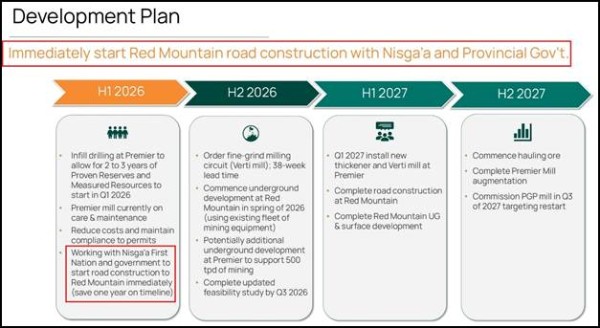
“Road building involves extensive environmental work,” continued McLeod, “which we are executing in partnership with the Nisga’a Nation.
The access road runs beside Bitter Creek. It’s fed by glaciers, which bring fine-grained material called rock flour. As a fish habitat, it’s poor. There’s no salmon, but you do get a few Dolly Varden trout.
On average, every fifty years, there’s a severe weather event that could cause sections of the access road to wash into the creek, negatively impacting the trout. For this reason, the Department of Fisheries & Oceans requires us to do a ‘fish offset’ – enhancing salmon habitat elsewhere. Working with the Nisga’a, we selected areas up in the Bear River Valley, where I used to fish as a kid.
In the late fall, when the salmon come up the rivers to spawn, they get slaughtered by eagles because there are no trees to provide cover. We are going to realign some creeks, put in stumps, old dead trees, archways, and narrow the channels so the vegetation can grow thicker. This will make it harder for the eagles to hunt the spawning salmon.”
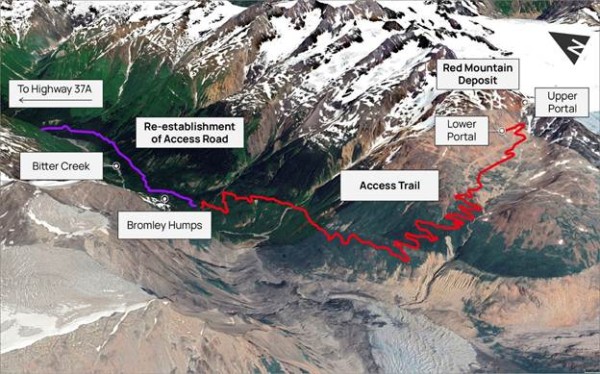
Above: Red Mountain Access Trail
“We also have a goat management plan that would restrict hunting,” McLeod told GSN. “When the wild goats are getting ready to have their babies, you don’t want to disturb them. The goats go high up into the alpine areas, where there is no chance we would stumble on them, but we limit the use of helicopters above 500 feet of elevation during the goat birthing season.”
There’s also an indigenous man who operates a trap line in the vicinity of the access road. He’s an old family friend. We’ve consulted him, made sure that our mining activities do not threaten his livelihood.”
“In the Golden Triangle, eagles, goats and trap-lines have environmental, cultural and economic importance,” added McLeod, “These are things the Nisga’a know a lot about. Having them as partners is helping us to improve and expedite our development and exploration programs.”
The original Cambria Gold press release is available here.
1. For additional information on the Red Mountain resource numbers, refer to the NI 43-101 Technical Report “Premier & Red Mountain Gold Project Feasibility Study” with a report date of May 22, 2020. The Red Mountain resource was authored by Gilles Arseneau, P.Geo., a Qualified Person as defined by NI 43-101.
Contact: guy.bennett@globalstocksnews.com
Disclaimer: Cambria Gold Mines paid Global Stocks News (GSN) $1,750 for the research, writing and dissemination of this content.
Full Disclaimer: GSN researches and fact-checks diligently, but we cannot ensure our publications are free from error. Investing in publicly traded stocks is speculative and carries a high degree of risk. GSN publications may contain forward-looking statements such as “project,” “anticipate,” “expect,” which are based on reasonable expectations, but these statements are imperfect predictors of future events. When compensation has been paid to GSN, the amount and nature of the compensation will be disclosed clearly.
Media Contact
Organization: Global Stocks News
Contact Person: guy.bennett@globalstocksnews.com
Website: https://www.globalstocksnews.com
Email: Send Email
Country:Canada
Release id:45696
The post Cambria Gold Mines Fast Tracks Red Mountain Road Build with the Support of the Nisga’a Nation appeared first on King Newswire. This content is provided by a third-party source.. King Newswire makes no warranties or representations in connection with it. King Newswire is a press release distribution agency and does not endorse or verify the claims made in this release. If you have any complaints or copyright concerns related to this article, please contact the company listed in the ‘Media Contact’ section

Disclaimer: The views, suggestions, and opinions expressed here are the sole responsibility of the experts. No Funds Pulse journalist was involved in the writing and production of this article.